 Floki
Floki Valhalla combines on-chain interactions with tactical creature battles
Updated:
How do you play Floki Valhalla? The Viking-themed blockchain game combines creature collection, upgradeable NFTs, and tactical battles. Players explore Floki Island, tame creatures called Veras, and develop teams with different combat roles. FLOKI supports the game economy, while access and funding requirements vary with the environment and account setup. Mainnet and Testnet offer distinct settings. The main playing decisions concern positioning, creature progression, and resources spent on attempts whose outcomes can vary.
In this guide
Key takeaway: A taming attempt spends an amulet, and its chance of success changes with the target’s condition and the selected equipment.
Exploration, taming, and team building
Valhalla pairs an explorable island with creature encounters and tactical combat. Exploration leads to wild Veras; taming expands the creatures available for a team. Battles put their abilities and positioning to use. Crafting, quests, and island services support those activities outside the arena. A team can field up to three Veras, so complementary abilities matter alongside each creature’s individual strengths.
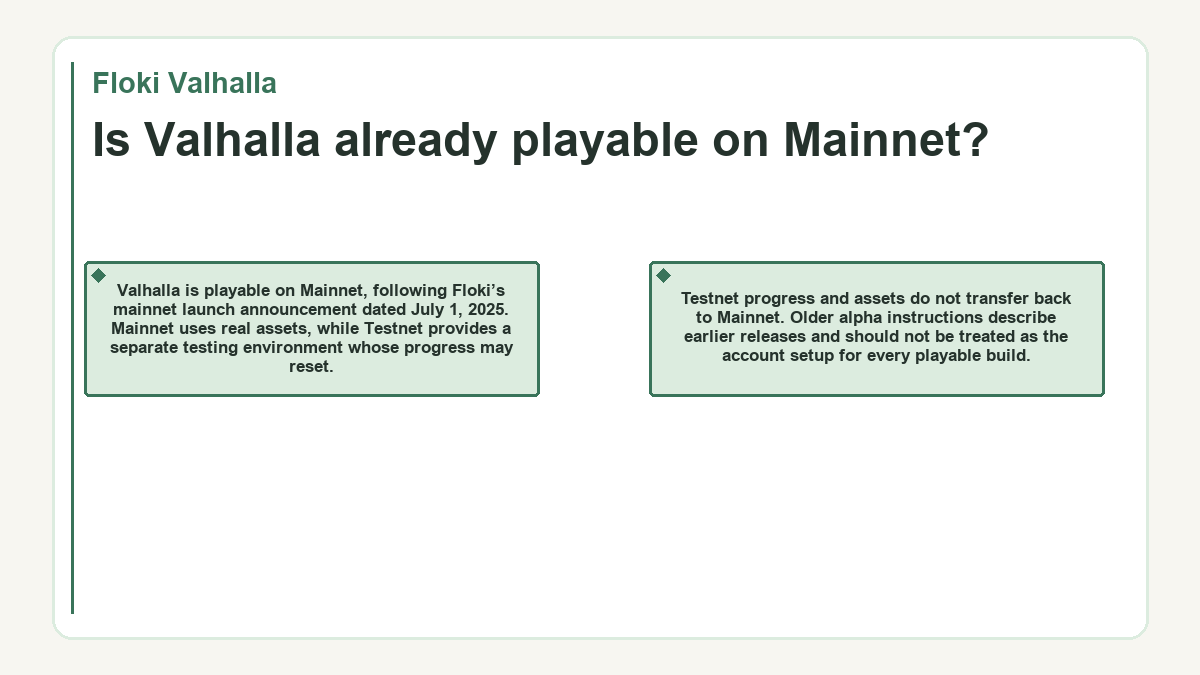
Is Valhalla already playable on Mainnet?
Valhalla is playable on Mainnet, following Floki’s mainnet launch announcement dated July 1, 2025. Mainnet uses real assets, while Testnet provides a separate testing environment whose progress may reset. Testnet progress and assets do not transfer back to Mainnet. Older alpha instructions describe earlier releases and should not be treated as the account setup for every playable build.
Does opening Valhalla require a FLOKI purchase?
Opening Valhalla does not require FLOKI, although a separate wallet holding FLOKI or xFLOKI can provide optional FLOKI Tier benefits. Designating a Valhalla account for those benefits does not transfer the tokens or grant that account control of the wallet. Account setup is transitioning toward social sign-in, with legacy migration prompts remaining in some environments. Certain legacy actions can still require BNB on opBNB when requested by the game; Testnet uses test funds.
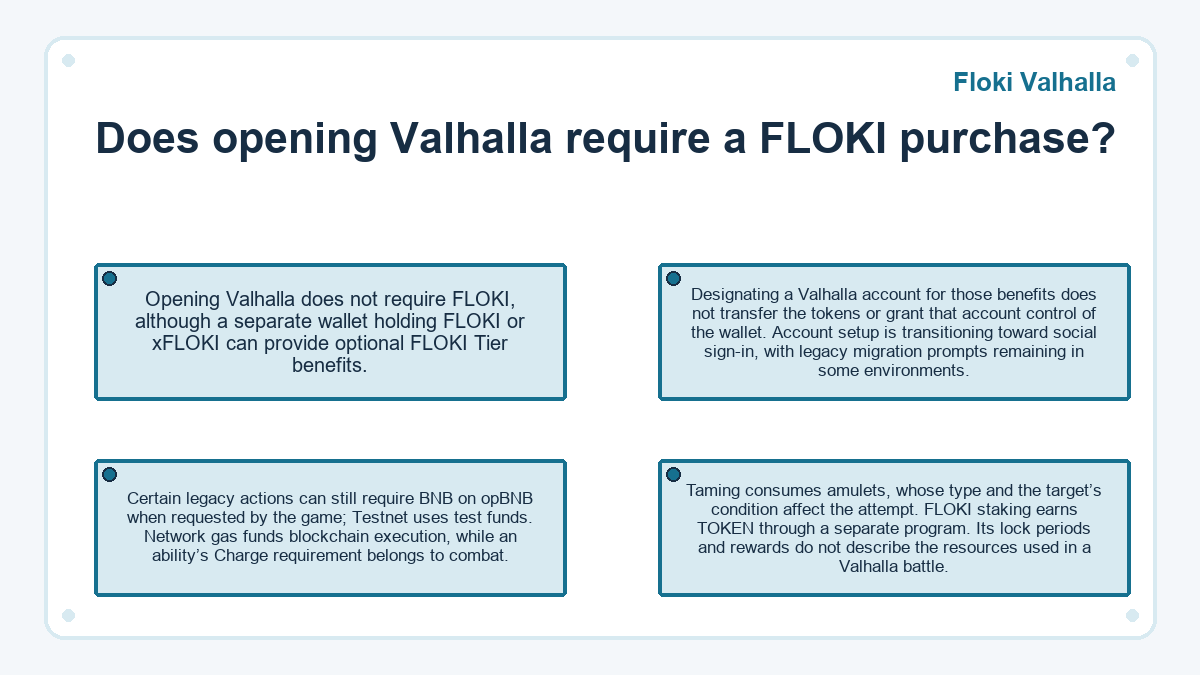
Network gas funds blockchain execution, while an ability’s Charge requirement belongs to combat. Taming consumes amulets, whose type and the target’s condition affect the attempt.
FLOKI staking earns TOKEN through a separate program. Its lock periods and rewards do not describe the resources used in a Valhalla battle.
Simultaneous turns and tactical positioning
Valhalla uses simultaneous-turn combat, with both sides choosing actions before the game resolves their choices through its battle rules. Movement resolves before other actions except taming in Vera encounters, which makes an opponent’s expected destination relevant to targeting. Range, affected tiles, and existing battlefield objects all influence whether a planned action can have its intended effect.
A Vera’s available actions include movement, skipping, an equipped ability, and permitted consumable use. Healing and Charge potions serve different resource needs; taming amulets apply only when the encounter allows taming. An ability aimed at a visible position can miss the intended target if that target moves. The battle preview and event feedback help explain how a choice resolved. A legal target tile establishes that an input is allowed, while positioning and the opponent’s hidden choice determine its tactical value. Coordination across the team also matters when one creature prepares an opening that another can exploit.
Vera abilities, runes, and stat growth
Vera progression develops a creature’s combat performance through levels and stat allocation, alongside the ability kit that belongs to its species. Level caps vary between Veras. Leveling does not unlock a Vera’s species abilities.
Species abilities and the battle loadout
Each Vera has four species abilities, and its equipped rune supplies an additional ability. The Combat Arsenal determines the loadout shown during battle. Rune families also change attack patterns: Hail and Sun target selected tiles, while Nature’s Earthquake begins around the caster and expands on the following turn. The active ability description supplies its exact costs and numbers, which matter when selecting a move.
Stat allocation
Valhalla separates six attributes, so a stat investment changes a particular part of a Vera’s performance. The relevant ability damage type helps identify that relationship.
Damage and corresponding defenses
Strength affects physical attack and defense against physical damage. Intellect has the corresponding role for magical damage, while Charisma affects primal attack and defense.
Health, critical hits, and Charge
Vitality determines the health pool. Dexterity affects critical chance and critical power, while Wisdom affects the Charge pool and regeneration. A Vera gains stat points when it levels up.
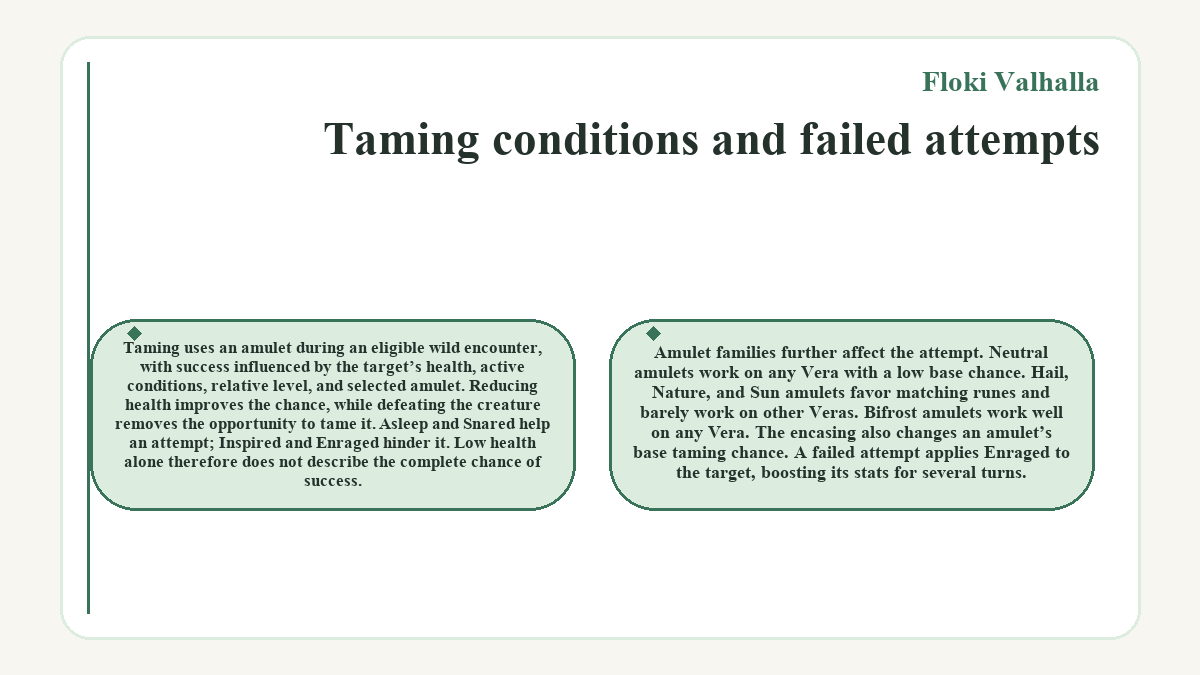
Taming conditions and failed attempts
Taming uses an amulet during an eligible wild encounter, with success influenced by the target’s health, active conditions, relative level, and selected amulet. Reducing health improves the chance, while defeating the creature removes the opportunity to tame it. Asleep and Snared help an attempt; Inspired and Enraged hinder it. Low health alone therefore does not describe the complete chance of success.
Amulet families further affect the attempt. Neutral amulets work on any Vera with a low base chance. Hail, Nature, and Sun amulets favor matching runes and barely work on other Veras. Bifrost amulets work well on any Vera. The encasing also changes an amulet’s base taming chance.
A failed attempt applies Enraged to the target, boosting its stats for several turns.
Amulet choices before an attempt or retry
Taming consumes an amulet for each attempt, making the number of attempts part of the resource cost. A prepared first attempt and a retry after failure need the same information about the target and equipment:
- Read the wild creature’s remaining health, active conditions, and level relative to the team.
- Check whether the chosen amulet works broadly or gains its advantage from a matching rune.
- For an initial attempt, keep the target alive and use a matching rune amulet or one that works on any Vera.
- Read the outcome as successful taming or a failed attempt that changes the target’s condition.
- Before a retry, reassess that changed condition instead of treating the next attempt as identical.
Lower health and suitable equipment can improve the setup without fixing the number of attempts required. Repeated failures can consume additional amulets, and each changed condition affects the next choice.
Blockchain assets and conditional game rewards
Valhalla runs on opBNB and includes blockchain-based assets such as Veras, amulets, and Runix alongside its upgradeable NFTs. Transactions recorded on-chain are publicly visible. Legacy Play Accounts automate transaction approvals during play. That account mechanism explains how blockchain interactions can occur without a manual wallet confirmation for every game action in those builds. Linking a legacy Play Account to its main wallet leaves the Play Account’s gas balance separate.
Loot chests offer another kind of reward, with contents that vary by rarity. Possible drops include potions, materials, amulets, and blueprints. Runix can appear in eligible chest types, excluding Vera and Rough Chests. The Blacksmith opens chests. An item reward can support another activity without representing a fixed FLOKI payout for playing.
Quest objectives and services around Floki Island
Valhalla’s quest system separates Journey objectives that introduce its world from rotating Daily and Weekly objectives. The active Daily set contains three short objectives; the Weekly set contains two longer ones. Journey progress remains separate from those rotating sets. The Quest Log displays the active objective, progress, remaining time, and reward.
Island locations provide services for those different activities. Floating Hamlets contains a shop and Daycare, while the Farmlands includes the Blacksmith, Bank, Tracker, and Daycare. Noob’s Landing provides the starting area and an Obelisk for travel. Clan Island is reached by ship. For rotating quests, the active objective and its remaining time determine what can still be completed before the next change.
Floki Valhalla: what people ask
Does Valhalla run on phones or support controllers?
Valhalla’s current game client requires a desktop or laptop with a keyboard and precise pointer. Phones and tablets can browse its website. Mobile gameplay and controller input are not currently supported.
Where do completed Valhalla quest rewards appear?
Completed quest rewards arrive in the in-game mailbox. Open the mailbox to collect the rewards.
Can a Valhalla account contain several Vikings?
A Valhalla account can contain multiple Vikings. My Vikings displays the characters associated with the active account and allows inspection of their Veras and details.
How can a Vera’s assigned stat points be changed?
Rumnesia allows a Vera’s stat points to be reassigned. It is used from the Vera tab in Inventory. The reset takes effect the next time that Vera is summoned into battle from the Combat Hub.
Is clearing browser data a safe fix for a legacy Valhalla account?
Clearing browser data can erase the progress of an unlinked legacy Play Account. Those accounts keep their progress locally, so do not delete site data until you have safely backed up the legacy play wallet’s seed phrase or completed the in-game migration. A legacy Play Account password cannot be retrieved or reset after creation.